
Bedtime Stories: Free Texts, Audio and a Sleepy Ritual
19/08/2026
Where to find free bedtime stories — to read, to listen to or to tell — and how to turn the evening story into a ritual that really ends in sleep.
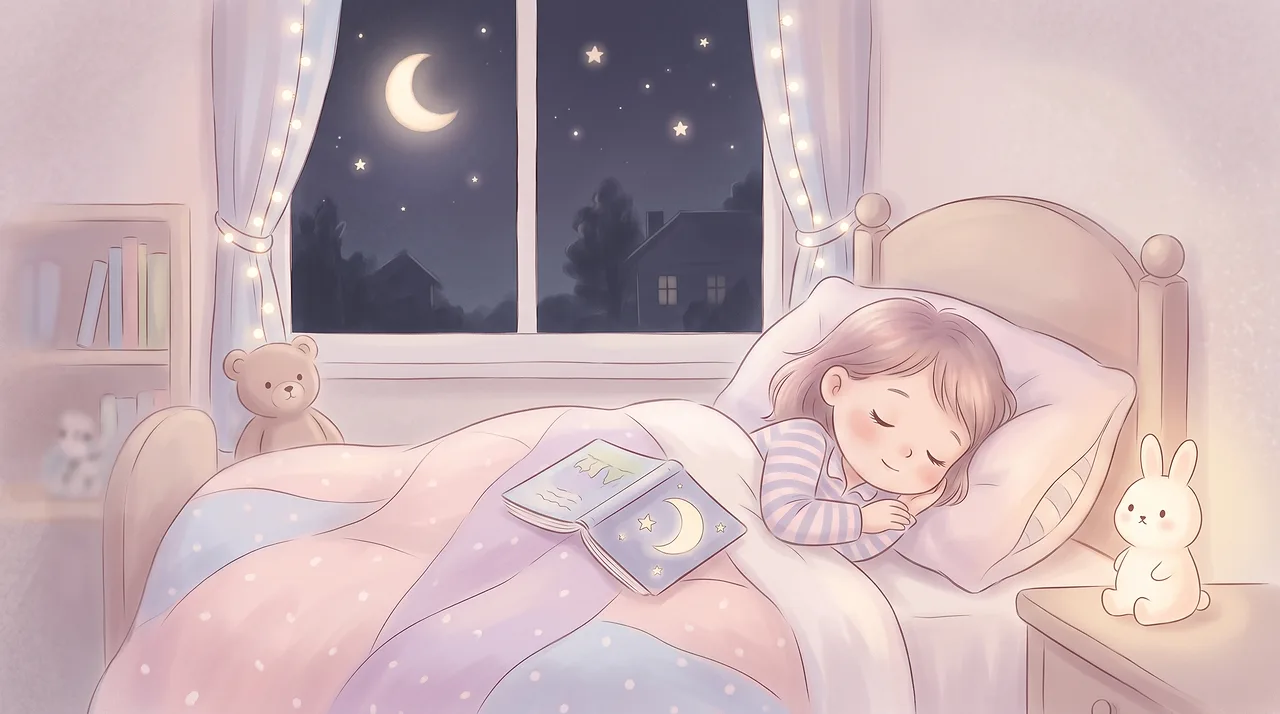
You can find free bedtime stories in a few places: public-domain classics to read are on Project Gutenberg Australia, and ABC Kids listen offers Story Time and music for little ones, free in the ABC listen app and on DAB+ digital radio. But when it comes to falling asleep, the ritual itself matters more than the choice of story: the same time, dim light, a calm voice and the same closing line every night.
How to choose a bedtime story by age
The most common reason a bedtime story “doesn't work” is simple: it doesn't suit the child's age. A toddler can't follow a storyline, and a preschooler gets bored with a board book. How reading stamina changes with age for books in general is covered in our guide to choosing books for children. A rough guide:
- 1–2 years: nursery rhymes and board booksThe rhythm and melody of your voice matter more than the plot. Short nursery rhymes and finger plays, and board books with one picture per page. Repeat them as often as you like — at this age repetition has a purpose; it isn't boring.
- 2–4 years: simple plots with repetitionCumulative tales where one more character keeps joining in, such as The Enormous Turnip or The Gingerbread Man. Before long your child is “reading” with you — saying the repeated lines together is a first step towards loving books.
- 4–6 years: classic storiesClassic fairy tales and Australian favourites such as May Gibbs's Snugglepot and Cuddlepie, Dorothy Wall's Blinky Bill or Mem Fox's Possum Magic. Your child can now follow a longer storyline and a simple moral. In the evening, though, pick the gentler ones — witches and dragons are best kept away from bedtime.
- 6 and up: serial readingA chapter every night. Looking forward to the next instalment is one of the strongest motivations to read at all — and it works even for children who can already read but don't feel like doing it on their own.
Free read-aloud and audio bedtime stories online
A read-aloud or audio story comes in handy when you're short on time, on the road, or when your child takes ages to fall asleep and your voice has had enough. How to choose an audiobook by age and type of sound is covered in our guide to audiobooks for children. Reliable free sources:
- ABC Kids listenThe free ABC audio service for children up to about five, with Story Time and music. You can play it whenever you like, not just at a set time, so it suits the end of the day.
- The ABC listen app and DAB+ radioABC Kids listen is in the ABC listen app and on DAB+ digital radio, so you can put on a quiet story or soft music as a background for drifting off.
- Children's TV programmesOne caveat: they mean a screen. As a “bedtime” story, TV works better in the afternoon — the light from a display right before sleep pushes falling asleep back. When video is enough as a story and when it isn't is covered in our piece on read-aloud stories on YouTube.
- Story podcastsPodcast apps have free read-aloud stories if you search for “bedtime stories” — quality varies, so listen to an episode yourself first. The evening rule for audio: sound only, no screen.
Bedtime stories to read: where to get free texts
Many classic fairy tales and older children's books are in the public domain. Project Gutenberg Australia (gutenberg.net.au) holds ebooks that are public domain in Australia, including a children's literature section, free and legal to read or print. Mind the Australian rule: a work published in the author's lifetime is free here if the author died before 1 January 1955. More legal sources of texts are in our article on children's stories to read online.
Just watch the language: old texts have long sentences and words today's children don't know. With preschoolers it's common, and perfectly fine, to simplify as you read — fairy tales were passed down for hundreds of years by retelling, not word-for-word quotation.
The other route is the library. Ask at your local library about a children's membership and you can borrow dozens of storybooks you would otherwise have to buy. For bedtime reading, the library is the cheapest source there is.
Reading from a book, audio, or telling a story yourself?
No option is “the right one” — each suits a different moment, so feel free to mix them depending on how the evening is going.
| Option | When it suits | Weak spot |
|---|---|---|
| Reading from a book | The core of the bedtime ritual — time together, closeness, the child sees the words and pictures | Takes your energy; after a hard day, parents nod off over the book too |
| Audio story | Car trips, sick days, or when a child takes a long time to fall asleep after the story | No closeness and no pausing for questions; the pace doesn't adapt to the child |
| Telling a story from memory | Lights are out and your child is still awake; the story can be made to measure | Making up a story after a long day is hard work — an outline helps (below) |
| Personalised book | As a gift and a fresh touch to the ritual — the child is the hero of their own story | Doesn't replace the everyday classics; it's one book, not a library |
A short bedtime story to tell from memory
The most useful story is one you can tell without a book — after lights out, on holiday, in the car. This one has a proven sleepy structure: the hero says goodnight to everything around him one by one, and with each goodnight your voice gets slower and quieter.
A bedtime ritual in five steps
A story sends children to sleep best as part of a predictable routine. Australia's reading initiatives, such as National Simultaneous Storytime and the Premier's Reading Challenge, are a reminder of how much reading aloud matters — and bedtime is when a daily read-aloud is easiest to keep up.
- 1Same time, same orderBath, pyjamas, teeth, story, lights out. Predictability tells a child's brain “now it's time to sleep” — more strongly than any amount of coaxing.
- 2No screens for an hour before bedNo TV or tablet, even if a story is playing on it. Light from a display suppresses melatonin and pushes sleep back.
- 3Let your child choose — but only from two or three booksHaving a say cuts down on negotiating. Choosing from the whole bookshelf, though, wakes them up; two or three books on the bedside table are enough.
- 4Read more slowly and quietly than feels naturalTowards the end of the story, lower the pace and volume even further. A yawn in the middle of a sentence isn't a mistake — it's a technique.
- 5End every night with the same lineA sleepy formula — say, “And now the whole forest is asleep. Goodnight.” — works like a full stop at the end of the day. After a few weeks your child will be saying it with you.
Mistakes that wake a child up rather than settle them
When bedtime reading ends with an overexcited child, it's usually down to one of these:
- Action-packed or scary storiesChases, battles and monsters belong in the afternoon. In the evening, choose stories where everyone settles down to sleep at the end — when the plot builds up, so do the kids.
- A long new story just before lights outA new story means questions, suspense and “how does it end?”. Read new books early in the evening, and finish with a familiar story or a short sleepy one.
- “Just one more” with no ruleNegotiating wakes children more reliably than caffeine. Agree on the number in advance (“two tonight, you pick which”) and stick to it — a rule that sometimes bends isn't a rule.
- Reading as a reward or punishment“If you're good, I'll read to you” turns the story into a tool. Bedtime reading should be a certainty that holds every day — that certainty is exactly what children fall asleep on.
When your child is the hero of the story
Children love stories about themselves — that's why stories featuring their name, their room and their teddy work so well. The printed version of that joy is a personalised book: at Hero of the Book, a single uploaded photo becomes a story in which the hero looks like your child and carries their name. Before you pay, you'll see a suggested title, a sample of the story and the dedication — but not the finished illustrations; the book is a one-off purchase, with no subscription.
For the bedtime ritual it's a fresh touch and a lovely gift, not a replacement for the everyday rotation of stories: it's one book, not a library.