Books for 8–10 Year Olds: Picks by Reading Stamina
20/08/2026
“Ages 8–10” on the cover describes a reader who barely exists. Picks for three real situations and how to tell where your child fits right now.
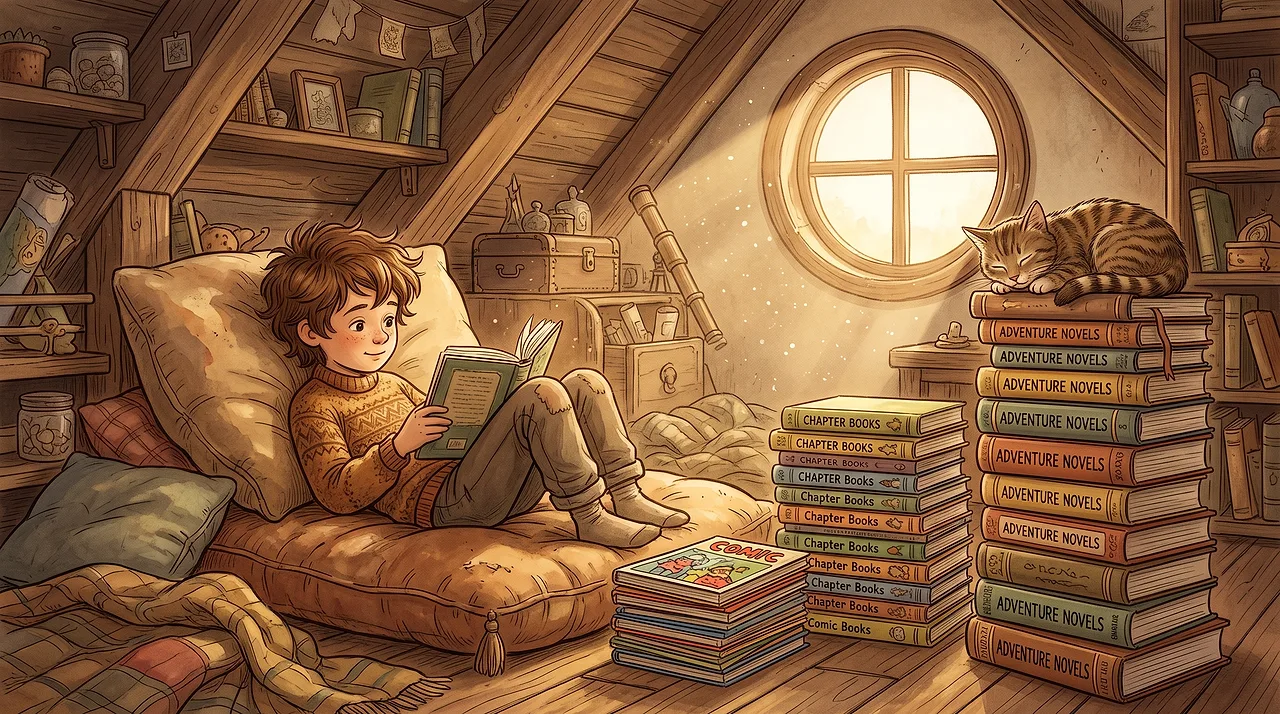
For children between eight and ten, choose books by reading stamina, not by the age printed on the cover. A child who gives up after two pages will love a comic-style diary like Diary of a Wimpy Kid or Dog Man; a child who can manage a chapter an evening will enjoy A Bear Called Paddington or The Magic Pudding; and a reader who devours a book over a weekend is ready for Harry Potter, Seven Little Australians or The Chronicles of Narnia. One school year group easily holds all three kinds of reader at once.
Why the age on the cover isn't enough
A label like “8–10 years” describes an average that almost no real child matches. In a Year 3 classroom, a reader still sounding out text word by word sits next to one who has already finished a seven-book fantasy series. Choose by age alone and you risk both kinds of failure: a book that is too hard convinces a child that “books aren't for me”, and one that is too easy bores them and feels a little insulting.
Stamina, on the other hand, shows at a glance — one evening of watching is enough, no tests needed. That's why the picks below are split into three groups according to how much a child can really stick with, and at the end you'll find a simple way to work out where your child fits. Choosing by interests and genre in general is covered in Children's books: how to choose by age, interests and reading stamina; here we go straight to specific titles for school-age kids.
When your child reads two pages and stops
Short stamina doesn't mean a child can't read — they just need text they can “nibble”. What works are books where the pictures carry half the story, the chapters are short and the jokes come quickly:
- Diary of a Wimpy Kid (Jeff Kinney)Diary entries with little drawings on every page and school humour any Year 3 kid understands. The text comes in bite-sized pieces that keep them reading “just a bit more” — and there are so many books in the series that it lasts for years.
- Dog Man (Dav Pilkey)A comic about a police dog with a police officer's body. Zany humour and very little text make it a reliable hook, even for kids who insist they “don't read”.
- Tom Gates (Liz Pichon)A school exercise book full of doodles, lists and jokes — the same idea as the Wimpy Kid, just with a more artistic hand. A good second choice once the Wimpy Kid books have all been read.
- Hilda (Luke Pearson)Comic adventures of a blue-haired girl among trolls, giants and spirits. A gentler, more richly illustrated alternative for children who don't click with schoolyard humour.
- The Bad Guys (Aaron Blabey)An Australian series of short, heavily illustrated chapter books. Quick to dip into, no commitment, happy to be read one book at a time — exactly what a reluctant reader needs.
A chapter an evening: the first “real” books
Once a child can stay focused for a whole chapter, the classic “middle” shelf opens up: continuous text whose chapters work as self-contained episodes, so they can be read evening by evening without losing the thread:
- A Bear Called Paddington (Michael Bond)Each chapter is its own little adventure and fits into one evening. The humour works just as well read aloud, so it's ideal for taking turns reading, parent and child.
- The Magic Pudding (Norman Lindsay)An Australian classic from 1918 about a pudding that never runs out and the friends who guard it. Funny, a bit outrageous and made for reading aloud.
- The Children of Noisy Village (Astrid Lindgren)Gentle episodes from a Swedish village. Ideal for children who don't need action but want to settle into a book and keep coming back to it.
- Geronimo Stilton (Elisabetta Dami)Mysteries with simple language and a fast pace. Here the series format is an advantage: a child knows what they're getting and reaches for the next book on their own.
- Pippi Longstocking (Astrid Lindgren)The strongest girl in the world, who does whatever she likes. Anarchy a child can at least read about, even if it's not allowed at home.
For the reader who devours a book in a weekend
A confident reader between eight and ten can follow a plot across a whole book — and this is exactly when it's decided whether reading will last into the teenage years. Offer them worlds they can disappear into for whole series:
- Harry Potter and the Philosopher's Stone (J. K. Rowling)The early books are written for exactly this age; the later, darker ones a child grows into. There's no need to read the series in one go — feel free to leave a break between books.
- Seven Little Australians (Ethel Turner)An Australian classic from 1894 about the seven lively Woolcot children. Family life, mischief and real feeling — and an ending worth reading together with a more sensitive child.
- The Chronicles of Narnia (C. S. Lewis)A way into fantasy for the whole family. Start with The Lion, the Witch and the Wardrobe — it's the most accessible and works perfectly well on its own.
- Ronia, the Robber's Daughter (Astrid Lindgren)Adventure, a friendship forbidden by the parents and a forest full of danger. A strong heroine and no magic — for children who don't take to fantasy.
- Percy Jackson and the Lightning Thief (Rick Riordan)Greek myths transplanted into the present day, told with cheeky humour. For confident readers around ten, the ideal step between Harry Potter and books for older readers.
How to tell which group your child belongs to
You can work it out at home in a single evening — without testing and, above all, without pressure. Your child doesn't even need to know you're watching.
- 1Have your child read one page aloudFrom a book that appeals to them. If they hit more than five words on the page that they can't read smoothly or don't understand, the book is too hard for now — the so-called five-finger rule.
- 2Watch what happens after two pagesDo they keep reading on their own? Then they belong at least in the middle group. Do they put the book down, fidget, ask how much is left? Reach for a comic or a diary series and come back to longer texts later.
- 3Notice what they go back toA book your child reads a second time is a better guide than one they were given and put aside. A series where they ask for the next book themselves shows you've got the difficulty just right.
- 4Try again in a few monthsReading stamina at school age grows in leaps. A book put aside at the start of the school year can be a hit by Christmas — don't throw it out, just put it back on the shelf where it can be seen.
Audiobooks for kids: reading with your ears counts
Listening isn't cheating, and it isn't a substitute for reading. While listening, a child soaks up vocabulary and story structure above the level they can read on their own — and that's exactly what makes reading with their eyes easier later. For reluctant readers, a combination works well: listen to a chapter while following the text in the open book.
For younger brothers and sisters, the free ABC Kids listen service has Story Time for children up to about five; audiobooks of most titles in this article are easy to find in the usual audiobook apps. A personalised book from Hero of the Book can also come with an audiobook for A$4.99 — a professional narrator reads the whole story (you can choose a male or female voice) and you listen right on the website. And if you mostly use audio at bedtime, have a look at bedtime stories with texts, audio and a ritual.
Where to find more “best books for kids”
Online shop charts rank books by sales, not quality. Awards where someone has actually read the books are more reliable: the Children's Book Council of Australia (CBCA) Book of the Year Awards have been given since 1946, and the Younger Readers category is the one to watch at this age. The winners and shortlists from recent years make a ready-made shopping list for when you run out of titles from this article. Classics that are public domain in Australia, including a children's literature section, are free to read at Project Gutenberg Australia. Reading aloud together gets a boost, too, from National Simultaneous Storytime, when one Australian picture book is read aloud at the same time in schools and libraries across the country, and from the Premier's Reading Challenge, a free state program with a certificate signed by the Premier for children who finish it.
And one last tip: take your child along when you choose, to the library or the bookshop. A book they picked themselves has a much better chance of being finished than the best-reviewed one handed to them ready-made. At home, it helps to keep books within reach — a shelf of their own at eye level does more for reading than any amount of reminding.
Sources
- Children's Book Council of Australia (CBCA) — Book of the Year Awards, including Younger Readers
- Australian Library and Information Association — National Simultaneous Storytime
- ABC Kids listen — free ABC audio for children, with Story Time
- Project Gutenberg Australia — public-domain ebooks, including children's literature