
Presents for toddlers: what to avoid
31/08/2026
Four things to avoid in presents for little ones: small parts, button batteries, yet another soft toy and toys that play by themselves.
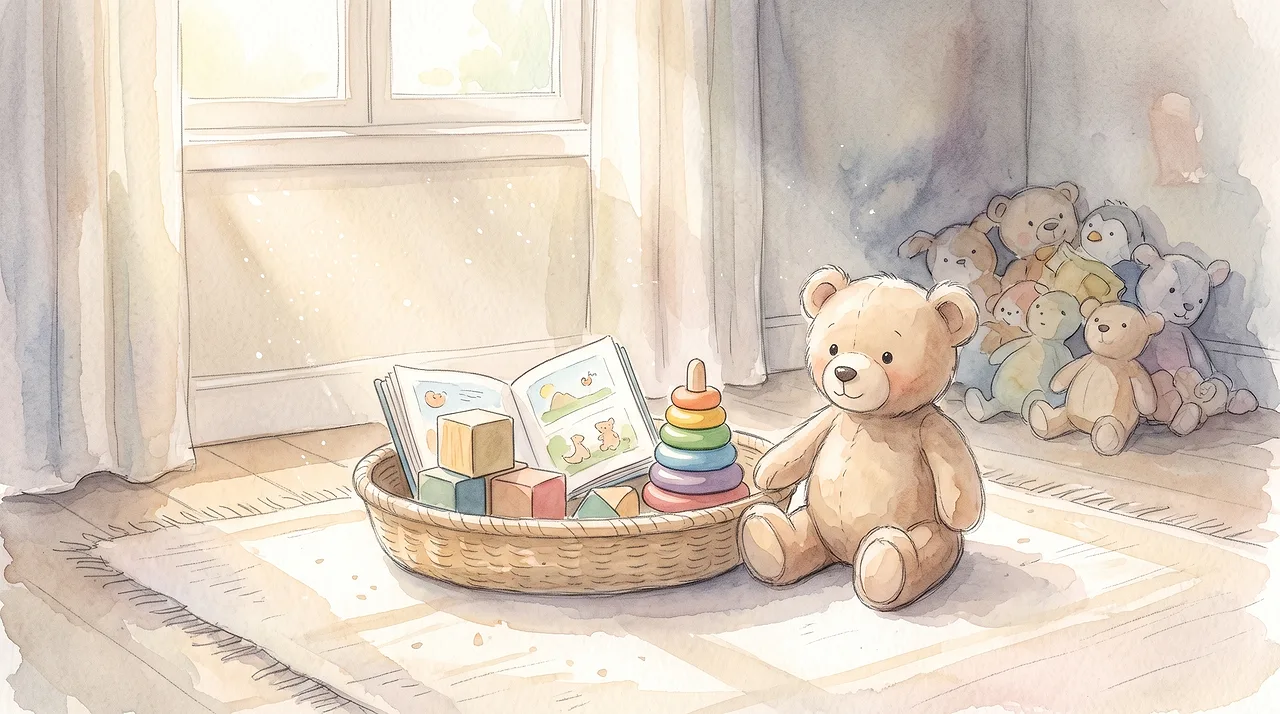
When you're choosing a present for a child under three, four things are worth steering clear of: anything that slips right through a toilet roll tube, anything with a button battery behind a click-shut cover, yet another soft toy for the pile that's already there, and toys that talk, light up and play all by themselves.
The first two are about safety, and there's no acceptable level of risk with either. The other two don't rule a present out — they just make it almost certain your little one will spend one afternoon with it and then stop seeing it altogether.
Small parts: what fits through a toilet roll tube
Safety standards check small parts with a test cylinder: neither the toy nor any piece that comes off it may fit inside completely. At home, a toilet roll tube gets you close — it's a little wider than the test cylinder, so the home test errs on the strict side rather than the lenient one. Put every new toy through it before you wrap it.
- 1Push it through the tubeAnything that drops right through the tube can be swallowed or inhaled. Don't just test the toy as a whole, test every part that comes off it too: wheels, beads, a figure's little hat, a magnet, the battery.
- 2Tug on everything that sticks outEyes, nose, bow, button, the sewn-in label. Pull as hard as a toddler bracing with both hands would, not gently with two fingers. With soft toys, what matters is whether the eyes are stitched on or glued.
- 3Check the joins, seams and battery coverAnything held on only by glue will come loose sooner or later. The battery cover must be held by a screw — a cover you can flick open with a fingernail can be opened by an eighteen-month-old too.
- 4Repeat the test after the first wash and the first fallMost small parts don't come out of the box — they're created later. A soft toy with a split seam or a chipped plastic figure is, from a safety point of view, a brand-new toy that nobody has checked.
- 5Take the label seriouslyAn age warning such as “not suitable for children under 3” isn't the manufacturer covering itself; it comes from the same small-parts measurement, and it goes on exactly the toys that aren't safe for the littlest ones. And in a home with two children, the younger one's age is the one that counts — a big sibling's toy always ends up within a toddler's reach.
Button batteries: a completely different kind of risk
A swallowed bead is a mechanical problem: either it passes or it doesn't. A lithium button battery is a chemical problem. When it lodges in the oesophagus, it creates conditions around itself that burn the tissue from the inside, and it only needs hours to do it. A flat battery from a remote control can do this too — even a voltage too low to run the toy any more is enough to cause damage.
The riskiest items aren't the toys you think about when you're shopping, but the things around them: light-up sneakers and bracelets, books that flash and play tunes, musical greeting cards, digital thermometers, remote controls, kitchen scales, LED tea lights, key rings, the bathroom scales. They make their way into the nursery as presents nobody thinks of as toys, so they never get checked.
So when you're buying, look at one thing above all: the battery cover must be held by a screw. The second thing is labelling — a toy with no brand and no traceable manufacturer is exactly the kind of item where nobody tested the small parts or the battery cover, and it's the kind that later gets recalled. Before you buy, it's worth checking Product Safety Australia's recalls. Store spare batteries out of reach, just like medicines, and don't leave used ones lying in the bin at home.
If you suspect your child has swallowed a battery, ring the Poisons Information Centre on 13 11 26 at once — the line is open 24 hours a day, 7 days a week, from anywhere in Australia — and follow their advice. Don't wait to see whether anything happens. Don't let your child eat or drink and don't try to make them vomit; keep the battery packaging or the toy itself, because the size tells the doctors what to look for. If your child is unconscious, not breathing or struggling to breathe, call Triple Zero (000) straight away. The other safety checks for this age group are covered in our article on safe presents for the littlest ones.
The soft toy avalanche: why the fifth bear is worse than the first
A soft toy is the most common present for a small child — and the thing every nursery has the most of. Yet a child bonds with one, two at the most. The rest are scenery that nobody cuddles but everybody tidies, washes and moves from the bed to the floor.
The problem isn't one teddy bear, it's the pattern: a soft toy is a present you can't get wrong, so it's what everyone reaches for when they don't have time to think. The result is a basket where your child can't find anything, because in a heap of twenty equally squishy things there's nothing left to discover. And the more soft toys there are, the less often the one that really matters gets washed.
Rather than adding to the pile, it's more practical to thin it out: pop some of the soft toys in a box in the wardrobe and swap them for the ones on display every few weeks. Your child greets the “new” ones as if they'd just been given them. And when the choice is yours and you want a present that won't vanish into the pile within a year, look for something with your child's name inside — a book where they're the hero, for example. No batteries, no small parts, 12 illustrated spreads, and the digital version is usually ready within 15 minutes. Presents that outlast the toy years are the subject of our article on keepsake gifts for a first birthday.
Toys that do more than the child does
The last category isn't dangerous, just quiet about its downside. You can spot it with a single question: who's actually active during play? When a toy talks, sings, flashes and drives around on its own, all that's left for your child is pressing a button and watching. Before you buy something like that, put it through four tests.
- The mute testTurn the sound off and ask what else the toy can do. If the answer is nothing, you've bought a speaker, not a toy.
- The how-many-games testThe more precisely a toy dictates how it's played with, the sooner it runs out. Wooden animals, blocks or a play kitchen set can carry ten different games; a talking toddler tablet carries one, and somebody else made it up.
- The close-to-the-ear testA child holds a toy right up to their face, not at arm's length like an adult in a shop. If the squeaking is unpleasant in your hand, it'll be unpleasant for them too — and you can turn the volume down with a bit of tape over the speaker.
- The flat-battery testA toy that does nothing without batteries stops existing the moment they run out. Nobody buys new ones, and it just lies there. Better to know that up front than after Christmas.
- What passes the testsOpen-ended toys where your child makes up the rules, and things that simply do the same thing every time: building blocks, a tea set, dolls without electronics, books. How to choose according to what your child is practising right now is covered in our article on presents for a one-year-old.
Four risks and what to give instead
| What to avoid | Why | What to give instead |
|---|---|---|
| Small parts and anything that fits through the tube | Under three, everything goes in the mouth, and washing and falls create new small parts | Large pieces made of one material, stitched-on eyes, wood without glued-on decorations |
| A button battery behind a click-shut cover | A lodged lithium battery burns the oesophagus within hours, even when it's flat | A screw-down cover, or a toy that doesn't need batteries at all |
| Another soft toy for the pile | Children bond with one; the rest just get tidied and washed | Thin the pile and rotate it; give something that won't vanish into it |
| A toy that talks and plays by itself | The toy is the active one; the child just adds a finger on the button | Open-ended toys and books where the child makes up the rules |
| Unlabelled goods with no manufacturer | Nobody tested the small parts or the battery cover; these are the items that get recalled | A labelled toy with a traceable manufacturer and an age label |
What you don't need to worry about
Lists of don'ts tend to keep growing, so for the record, here's the other side. Plastic isn't automatically worse than wood — what matters is the size of the parts, how firmly they're joined and the labelling, not the material; a wooden toy with glued-on eyes is more dangerous than a properly moulded plastic cup. Second-hand toys from friends are fine, just give them the same once-over as new ones, because they've been through a few extra washes.
Worrying that your child will get “too few” presents doesn't get you anywhere either: a child under three can't compare the number of parcels, but they can tell how much time someone spent with them. And a toy your child puts aside after a week isn't a wasted present — some things simply suit three months of development and then get outgrown. The only real mistake is the one you could have seen coming.
What to tell family so they don't buy another pile
The hardest part of “what to avoid” isn't the choosing, it's telling grandparents, godparents and friends in a way that doesn't sound like criticism. These three messages are ready to copy and send.
Sources
- Product Safety Australia (ACCC) — The ACCC's product safety site, including the mandatory safety standard for toys for children up to and including 36 months of age (small parts and choking).
- Product Safety Australia: recalls — Where recalled products are published — worth checking for a toy before you buy it or pass it on.
- Directive 2009/48/EC on the safety of toys — The European rules behind the “not suitable for children under 3” warning seen on many imported toys. They have no legal force in Australia, so a toy withdrawn in the EU is not automatically recalled here.
- National Capital Poison Center: Button Battery Ingestion — An overview of how a button battery damages tissue and what to do if you suspect it has been swallowed.