
18th birthday gift for a son: money, papers, a keepsake
30/09/2026
Turning 18 isn't just another birthday, it's the first day as an adult. How to build a gift from money, practical papers and one thing that lasts.
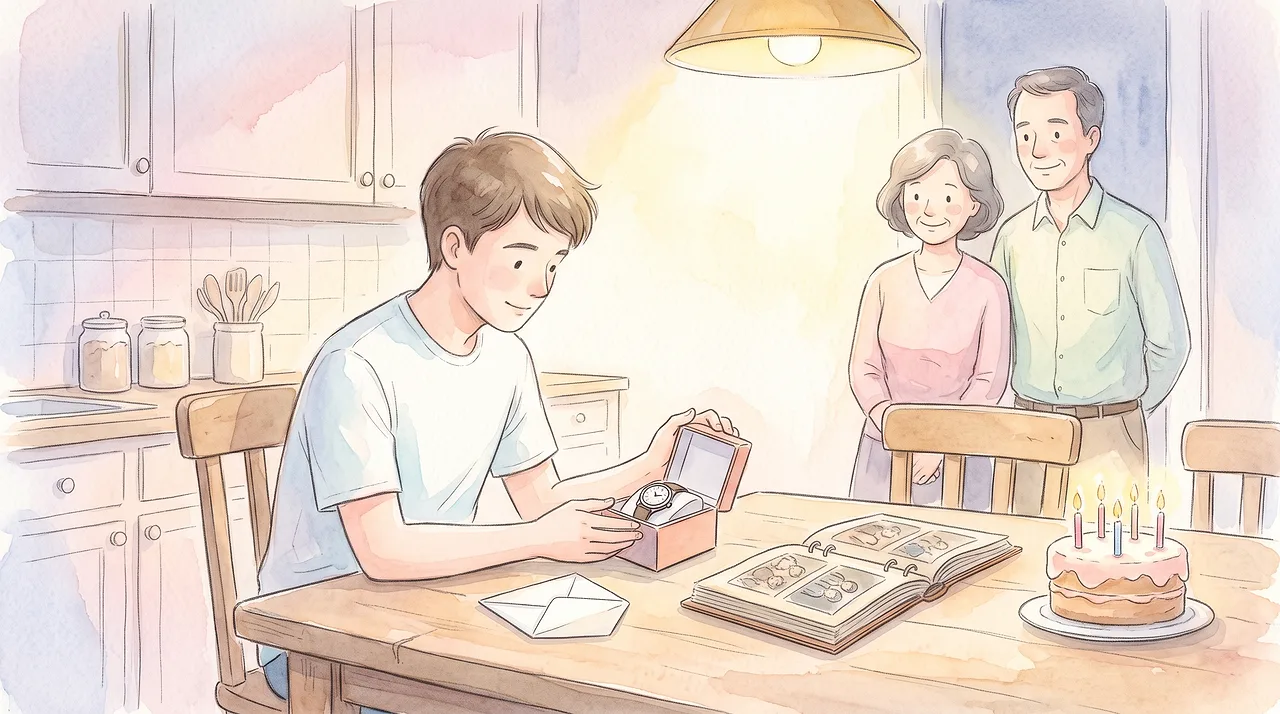
The gift that works best has three layers: money he manages on his own for the first time, papers that open up adult life (driving lessons, his own account, a course), and one keepsake that will still be sitting in a drawer twenty years from now. Money and papers take care of "now", the keepsake takes care of "for ever" — and that third layer is the one most often left out at 18.
18th birthday gift: chapters of this guide
Why turning 18 calls for a different gift
Turning 18 is when a son becomes a legal adult in most places. He can sign contracts on his own, take out a loan and make decisions about his own account, and his parents step back from making those decisions for him. The exact rules vary, so check the ones where you live.
A gift that ignores this looks like a 17th birthday present a year late. Another pair of headphones or a game is fine, but nobody will remember it in ten years. An 18th is one of the few days when it makes sense to give something that changes his situation: his own money, his own document, his own decision.
And because it's a transition, it also calls for a look back. Parents hold eighteen years of photos, stories and small things their son doesn't know or doesn't remember. That's the one part of the gift nobody else can give him.
Money: how to give it so it doesn't disappear
Money is the most common 18th birthday gift and nothing anyone needs to be embarrassed about. The problem isn't the money, it's that an envelope dissolves into everyday spending and a month later there isn't even a memory of it left.
- An envelope with a purposeWrite down what the money is meant for: "towards your first car", "for a trip you choose". He doesn't have to spend it on exactly that, but he knows what his parents had in mind when they gave it.
- His own account instead of a kids' oneIf your son has a children's or student account, ask the bank what happens to it on his 18th birthday. Parents often lose access and he signs the paperwork himself — a good chance to go to the bank together and move the gift there too.
- An investment account or fundA modest sum paid into an investment account in his name will teach him more than a lecture on saving. Let him choose what it goes into, and go through it with him now and then during the first year.
- Money for a specific experienceA paid-for flight, a music festival with mates or a weekend away. Here the money turns into an event that gets remembered.
- Tax: worth a quick checkA birthday gift from parents and grandparents is usually a private family matter, but the rules on gifts differ from place to place. If a godparent, uncle or aunt is giving a larger sum, check the rules where you live rather than assuming. With bigger amounts it's worth making a bank transfer with the reference "gift for 18th birthday" — for your own records and clarity.
Papers: 18th birthday gifts for a boy that come as a document
The second layer is things that come on paper — a voucher, a contract, an enrolment. He gets them in an envelope, but their value only shows a few months later.
- Driving lessonsLessons towards a car licence are a classic because they're practical. A paid set of lessons beats "we'll chip in": a booking with a start date gets him going.
- A course or certificateA language course, a welding or diving certificate, first aid, coding. Choose by what he enjoys now, not by what might come in handy.
- A membership that moves him forwardA year at the gym, an online course, season tickets for his club. The bonus: the gift reminds him of you every week.
- His own keyWhere possible, a key to the car, the holiday shack or the workshop, with the agreement that from now on he's responsible for it. For some young men this is the biggest gift of all.
One keepsake that lasts
Money gets spent and a course ends. The third layer is something your son will pick up in twenty years and remember who gave it to him and why. It doesn't have to be expensive — it has to be his and it has to carry a date.
Tried and true choices are an engraved watch (the date and a few words on the back), a ring or chain that belonged to his grandfather, or a knife or tool with his initials if he likes working with his hands. How to choose an engraving and when to give it is covered in the article on jewellery with a name and date — the same rule applies to an adult: short wording that won't make him cringe in ten years.
The second path is a look back at his childhood. A letter his parents wrote long ago that gets opened right now — see a time capsule and a letter to the future. Or an album of his childhood photos with the stories only Mum and Dad know written alongside.
For families who love a laugh, a book in which little him is the hero works too. A single childhood photo becomes an illustrated story with his face from his kindy days, plus a dedication from his parents. The digital version costs A$11.99 and is usually ready within 15 minutes; the hardcover print costs A$54.99 and delivery takes 7 working days, so order it well ahead. An 18-year-old probably won't read it over and over — but he'll pull it out when he has kids of his own.
Comparison: what's left in five years
| Gift | What it gives now | What's left in five years | What to watch out for |
|---|---|---|---|
| Cash in an envelope | freedom | usually nothing | without a purpose it dissolves into everyday spending |
| Investment account | his first own decision about money | the savings and the experience | let him choose, otherwise it isn't his |
| Driving lessons | independence | a licence for life | book him in with a date, not just a voucher |
| Experience (trip, festival) | time together with mates | photos and stories | let him choose who goes with him |
| Engraved watch | a grown-up object | something he wears or keeps | keep the engraving short |
| Letter or childhood album | emotion, often only years later | a memory nobody else has | write specific stories, not general wishes |
How to put the gift together: the last month
- 1Set a budget and split itPut most of it into money or papers, a smaller part into the keepsake. The keepsake doesn't have to be expensive, just well thought out.
- 2Talk to the familyGodparents and grandparents often want to contribute. Instead of three envelopes, each can add one layer: Grandma the keepsake, a godparent the course, the parents the money.
- 3Order anything with a lead timeEngraving, printing an album or a book and making jewellery take days to weeks. Sort this out first.
- 4Write the letter or dedicationTwo or three specific memories and one sentence about the future. You'll find examples below and in the article on book dedications.
- 5Hand it over in orderPapers and money first, the keepsake last. What's given last is remembered longest.
18th birthday dedications to copy
Sources
- Australian Government Style Manual — guidance on writing names and possessives ("For Thomas's birthday") in dedications