
Christening Gifts: Who Gives What and How to Avoid Doubles
20/09/2026
Godparents, grandparents, guests and parents each bring something different to a christening. Who gives what, what to skip and how to avoid doubles.
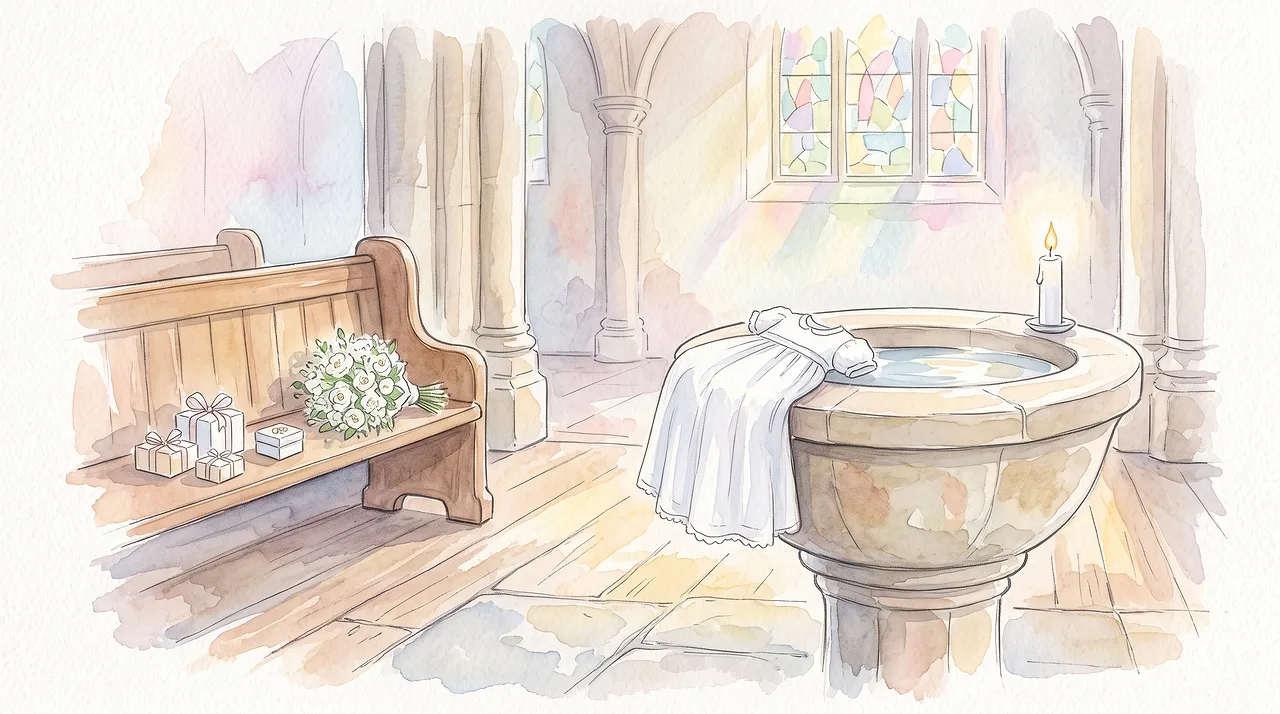
A christening calls for a keepsake, not everyday goods — the family received the basics when the baby was born. The main gift traditionally comes from the godparents (engraved jewellery, a baptismal candle and a white gown), grandparents add something of lasting value or savings, guests bring something small and the parents arrange a memento of the day itself.
Splitting gifts by role isn't etiquette for its own sake. It has one job: to stop four people who each independently choose “a keepsake with the name and date” from turning up with four versions of the same thing.
Guide: christening gifts by type
This article is a map of the whole topic. The chapters below are detailed guides to each type of gift — here you'll find out which one belongs to whom and how to combine them so they don't overlap.
Why a christening gift differs from a birth gift
For most families, a few months pass between the hospital and the christening. By then the family has a wardrobe full of onesies in three sizes at once and a pile of soft toys, of which the child will love exactly one. A christening is about something else: it is a ceremony where the child is named before a community and two adults take on a role they will play for years. Many Australian families now hold a civil naming ceremony led by a celebrant instead, where the godparents may be called “guideparents” — the logic of the gifts is the same. The gift should match: it carries a name and a date and is meant to last.
Practical things aren't banned; they simply move from the main gift to the small gifts from guests. The difference is simple: in ten years you can pick up the main gift and show it to someone, while everyday presents will have been eaten, crawled through or outgrown by then. What a family usually receives straight after the birth is covered in baby gifts for a new arrival — whatever is ticked off there, don't buy again for the christening.
With keepsakes, one thing decides: whether there is something in them that can be made only now. An engraving with the date of the ceremony, a hand print in a size the child will never have again, a photographer for half an hour outside the church, or a book in which the child is the hero, with 12 illustrated spreads bearing their name. A generic gift from a department store has none of this and could be swapped for anything else.
Who gives what: the giver roles side by side
Read the table as a split of roles, not a shopping list. Once you have shared out the roles in advance, the rest of the choosing won't create doubles.
| Role | What is expected | What to avoid |
|---|---|---|
| Parents | A memento of the day itself — photographer, album, book, prints. The child keeps it from them forever. | Buying themselves a gift instead of asking someone in the family to give it. |
| Godparents | Engraved jewellery, a baptismal candle and a white gown, or a first sum put aside in savings. | A toy. A godparent's gift should outlast the playroom, not fill it. |
| Grandparents | Lasting value: savings, jewellery or a watch kept until adulthood, a keepsake book. | Furniture, prams and balance bikes without asking — parents have usually chosen these already. |
| Sibling | Something small they choose themselves: a drawing, a soft toy, a dedication in their own handwriting. | A gift picked by the parents that the sibling put nothing into. |
| Guests | Something practical one size ahead, a book, or an envelope with a note saying what it's for. | Jewellery with the name — that belongs to the godparents and is the easiest gift of all to double up. |
Godparents: a gift with a name and a date
You can't buy godparenthood with a gift, but it is the one role where a gift is expected almost automatically. The role itself does have rules: in Catholic practice a godparent must be a baptised and confirmed person who has completed their sixteenth year, is not the child's father or mother, and lives the faith they are meant to help pass on. Other churches have their own rules, so ask in the family's church. There are no rules for the gift — but what suits follows from that very role.
It is also worth knowing what being a godparent is not: it is a church and family role, not a legal arrangement. Who would care for the child if the parents couldn't is a separate legal question — check the rules where you live. A godparent is a relationship, not an insurance policy, and the gift reflects that.
The liturgical part. In many parishes the godparent carries the baptismal candle, lit during the ceremony from the Easter candle, and the white gown. Both are customs, not obligations: in some places the parents provide them, elsewhere the parish does. One question to the priest or the parents settles it in advance and saves buying a second candle.
The lasting part. Engraved jewellery (a cross, a locket, a bracelet), a watch put away until adulthood, a sum saved in an account run by the parents, or a keepsake with the child's name. With jewellery, it pays to engrave the back with the christening date, not just an initial, and to expect the child to wear it many years later. Which metal to choose and what fits on a small surface is covered in jewellery with a name and date.
Grandparents: one gift now, another for adulthood
With grandparents, two different things often get mixed up, and it is worth separating them. The first is a gift the child has in hand straight away — a keepsake the parents photograph and put away. The second is a gift the child will only see as an adult: savings set up by the parents, jewellery or a watch put away in a box.
A gift for adulthood has one condition people forget: someone has to find it and know what it is. A savings account with no paperwork in the parents' folder, and a box with no explanation of who it is from and why, will in twenty years either get lost or mean nothing to anyone. That is why such a gift needs a written letter — when it was written, for what occasion and what the giver wished at that moment. How to write it and where to keep it is in a letter to the future and a time capsule.
One last thing grandparents often wonder about: big items such as a pram, a cot or a car seat. They don't suit a christening, not because of etiquette, but because parents usually have one already or choose it based on things the giver doesn't know. Here asking first is a must, even if the gift loses its surprise.
Guests: something small that really helps the parents
A guest has the smallest role and the smallest risk of missing the mark — as long as they stick to things that don't double up into uselessness.
- An envelope with a note saying what it's forMoney isn't impersonal once you add the intention: for the photographer, for savings, for a first outing. Parents almost always put it to better use than another thing for the wardrobe.
- Clothes one size aheadA guest's most common mistake is the size the child wears right now. Buy what they will grow into next season, and leave the tag on so it can be exchanged.
- A book to read aloudA board book or a bedtime story works even for a child who, for now, only chews the corner. A dedication on the title page turns it into a keepsake — find inspiration in a dedication in a book.
- Something for the parents, not the childThey are hosting the christening and are usually worn out afterwards. A home-cooked meal, a café voucher or an offer to babysit is a gift nobody talks about and everyone remembers longest.
- Nothing with a name and datePersonalised gifts overlap more often than anything else, and godparents and grandparents usually claim them. As a guest, stay clear unless you have explicitly agreed otherwise.
How to coordinate so gifts aren't doubled up
Coordinating sounds like an unnecessary formality until three lockets with the same date land on the table. It takes one message.
- 1The parents start, not the guestsWithout their lead, everyone asks separately, late and only the people they know. It also gives the parents the right to say what they'd rather not receive.
- 2List what's already at homeGo through the wardrobe and shelves: clothing sizes, Grandma's jewellery, the album someone gave at the birth. A list of what's ticked off is more useful than a wish list.
- 3Split roles, not specific itemsJewellery and the liturgical part for the godparents, lasting value for the grandparents, something small for guests. A role leaves the giver free to choose and still rules out doubles.
- 4Send it in one message with the invitationOne message to the group does more work than five phone calls and embarrasses no one, because everyone gets the same thing.
- 5Leave one option openAnyone who doesn't want to ask needs somewhere to go: an envelope, a book or photos of the ceremony are gifts that won't double up into uselessness.
- 6Note who gave what during the partyA note on your phone is the basis for thank-you cards and, a few years on, the only place to find out who that jewellery was actually from.
What to write in a christening card
The card decides whether a gift is a thing or a keepsake. The wording below is ready to copy — just add the name and date.
What to avoid at a christening
The most common mistakes aren't expensive, just pointless — and all three can be caught with one question in advance.
Jewellery the baby is meant to wear straight away. A necklace for a baby is a gift for the box, not for the neck: loose cords, chains and beads on a sleeping or crawling child mean a risk of strangling and swallowing, and parents take them off anyway. The engraved date loses nothing; the handover simply moves to a time when the child understands it.
Clothes in the current size. The guests' most common gift and the item most likely to end up, tag still on, in the bag for exchanges. One size ahead costs the same and actually gets worn.
A religious item without asking. For a family that sees the christening mainly as a family celebration, a picture of a saint or a rosary misses the mark; for a practising family it is welcome, but that is exactly where three identical ones turn up. Asking isn't tactless; guessing is.
And one last thing that doesn't look like a mistake: a gift bought at the last minute just because “you have to bring something”. The date of a christening often depends on when the church is free and can come at a few days' notice. Even so, there is time for a gift with a name — a personalised digital book from Hero of the Book is usually ready within 15, so it can be made even the day before the ceremony, and in families where one child already has a book, it works as the next in the series. Any of these beats a fourth soft toy.
Sources
- Code of Canon Law (CIC 1983), cann. 872–874 — requirements for a godparent at baptism
- Australian Bureau of Statistics, 2021 Census — religious affiliation in Australia